
Descanso Gardens
Contents
Descanso Gardens lies in the San Rafael Hills of La Cañada Flintridge, where for three decades Mike Kobeissi has worked the market, and its name invites a confusion between two quite different ranchos. One was a Spanish land grant of the 1780s, measured in tens of thousands of acres and run for cattle. The other was a private estate of the 1930s, a few hundred acres at most, whose owner chose the word rancho for its old California sound. The garden visitors walk through today sits on ground that belonged to the first and was shaped almost entirely by the second.
Rancho San Rafael and Rancho del Descanso
The older rancho is the one in the history books. The American Camellia Society’s account of the garden begins with the Gabrielino people of the basin, who relied on the native oaks of this natural bowl and pounded acorns into meal for mush and bread. Spain’s claim dates to 1769, when Gaspar de Portolà came north from San Diego along the route later called El Camino Real and claimed the area for the king. Governor Fages then deeded the site, as part of a rancho of more than 36,000 acres, to Corporal José María Verdugo in 1784. After Verdugo died in 1831 his estate was divided between his son Julio and his daughter Catalina, and the property stayed in the family until 1869, when its sale set off decades of land deals that cut the surrounding country into smaller and smaller pieces.2 That chain of title is traced in the ranchos of the Crescenta Valley.
The hills that became the garden were skipped by that run. The same account says the acres that now form Descanso Gardens had never been developed when E. Manchester Boddy, a Los Angeles publisher, bought them in 1937. He named his place Rancho del Descanso, Spanish for ranch of rest, and later bought 440 more acres to the north, whose mountain streams still feed the garden with spring water.2 The second rancho, in other words, was a name and not a grant. KCET’s Lost LA film on the garden frames the whole sequence as a passage from a pre colonial oak woodland to a living museum, and reads the garden as a record of how Los Angeles changed socially, politically and culturally.4
The Boddy estate at its height
- bought in the San Rafael Hills in 1937
- 165 acres
- camellias on more than 20 planted acres at the peak
- 60,000
- year the estate was sold to Los Angeles County
- 1953
- year of listing in the National Register of Historic Places
- 2021
The Boddy estate, 1937 to 1953
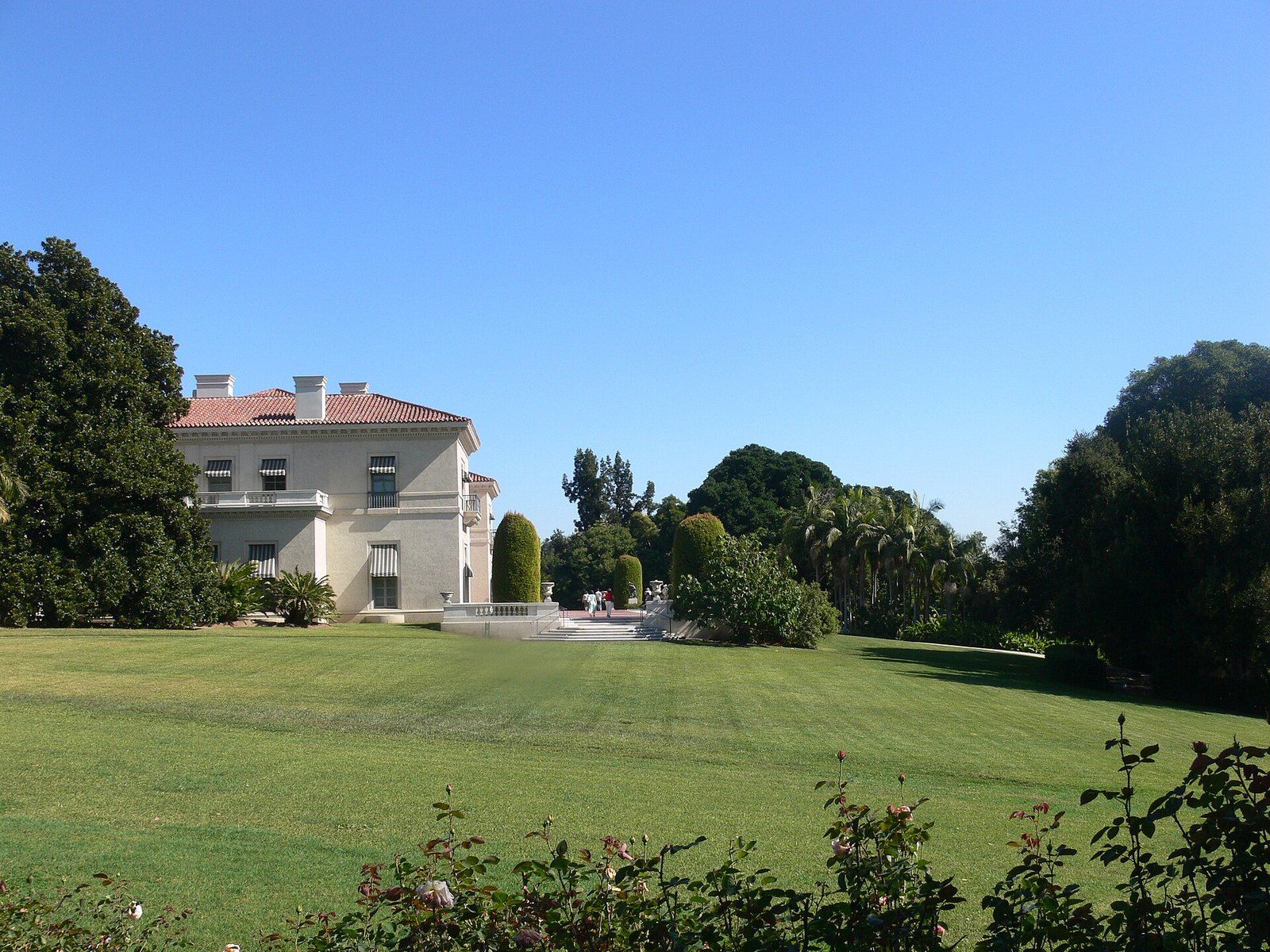
The Cultural Landscape Foundation’s record of the site puts Boddy’s purchase at a 165 acre tract and says the architect James Dolena finished the mansion in 1938 on a hillcrest facing the San Gabriel Mountains.1 A Los Angeles Times report on the house describes it as a two story Hollywood Regency mansion of 22 rooms, overlooking 25 acres of live oak forest and a driveway lined with camellias.3
The camellias were a business before they were a display. Boddy planted thousands of them among the coast live oaks and chaparral of the hills, in the shade of the trees, to supply blossoms to the cut flower trade, and many of those shrubs, with others added later, still grow there.2 At its peak the estate held more than 20 acres planted with 60,000 camellias. In 1941 Boddy hired the camellia propagator J. Howard Asper and opened a commercial nursery on the property, and soon afterward he engaged Dr. Walter E. Lammerts to breed roses and lilacs and lay out a five acre rose garden, finished in 1948.1
From private estate to public garden
The estate became public in two steps. Boddy sold it to Los Angeles County in 1953, and in 1993 the county handed management to the Descanso Gardens Guild. Together they developed 80 acres of gardens out of the Boddy landscape, adding lilac and iris gardens, a bird sanctuary and an eight acre native plant garden made with the nurseryman Theodore Payne.1 The garden’s page on that California Garden dates its opening to 1959, credits the design to Payne as an early champion of planting suited to the local climate, and lists what it shows in spring and summer: palo verde, California poppies, ceanothus, buckeye, the large white Matilija poppy, monkey flowers and fairy dusters, followed by muted foliage once the natives go dormant in the dry season.6
Two more gardens followed. In the early 1960s the Guild built a Japanese garden with a koi stream, an arched bridge, a pool with waterfalls, maples, bamboo and a teahouse designed by Wayne Williams and Whitney Smith.1 Los Angeles Magazine’s guide to the region’s Japanese gardens singles out its tile roofed tea house and the shade of its Japanese maples and cherry trees.5 In 1994 the old rose garden was rebuilt as the International Rosarium, more than 4,000 rose bushes arranged in 20 themed rooms that trace the history of the plant, and in 2021 the whole landscape was listed in the National Register of Historic Places.1
Acres by use in the Descanso landscape
The collection and the house now
The camellias remain the core. The American Camellia Society calls the collection the largest of its kind in North America, counts somewhere between 15,000 and 30,000 plants in more than 700 cultivars and species, and notes its designation as an International Camellia Garden of Excellence. The plants bloom from early autumn into spring, heaviest in January and February.2 The gap between that count and the 60,000 of the estate years is a difference of dates and of method, not necessarily an error in either source; acreage figures vary the same way, from 150 to 165 acres depending on what each writer counted.1 2
The mansion has taken on new uses too. By 2006 the Boddy House served as a gallery for local artists and a venue for events, and in 2007 it became the Pasadena Showcase House of Design, the first time in that program’s 43 years that it had partnered with the Guild. The house opened to visitors that April for a month, with a market of vendors set up under the oaks. The county owns the gardens; the Guild, then about 11,000 members strong, maintains and runs some 160 acres.3 Like the earlier Lanterman House, the property moved from one family’s ownership into civic care.
The garden’s history is the subject here, not the streets around it, and a buyer wondering how a nearby landmark bears on one specific house is better served by their own advisors than by a reference entry. The table below closes the confusion the entry opened, setting the Spanish grant beside the estate that borrowed its vocabulary.
Rancho San Rafael and Rancho del Descanso
| Rancho San Rafael | Rancho del Descanso | |
|---|---|---|
| What it was | A Spanish grant to Corporal José María Verdugo | A private estate named by E. Manchester Boddy |
| When | Granted 1784; in Verdugo hands until 1869 | Bought 1937; mansion of 22 rooms by J. E. Dolena |
| Size | Over 36,000 acres | About 150 acres that form the gardens, plus 440 acres to the north |
| Use of the oaks | Grazing country in a Gabrielino acorn landscape | Camellias planted in their shade for the cut flower trade |
References
- The Cultural Landscape Foundation. Descanso Gardens, 2013 10 26.
- American Camellia Society. Descanso Gardens, La Cañada Flintridge, California, 2019 01 01.
- Los Angeles Times. Boddy House New 'Showcase House', 2006 11 09.
- KCET. Special: Descanso Gardens, 2017 07 18.
- Los Angeles Magazine. Where to Find L.A.'s Most Exquisite Japanese Gardens, 2016 12 01.
- Descanso Gardens. California Garden, 2024 08 20.
External links
See also
-
 La Cañada Flintridge History
The Tongva and the Arroyo Seco
Tovaangar's villages, trails and acorn economy left traces that still frame what is known of the foothills.
-
 La Cañada Flintridge History
The Ranchos of the Crescenta Valley
From the Verdugo grant of 1784 to Briggs's ten acre lots and Flint's subdivision, the chain of title behind the valley.
-
 La Cañada Flintridge History
Lanterman House
A doctor's family home, a ballroom that waited decades for a dance, and the archive the town keeps inside its walls.
-
 La Cañada Flintridge History
The Arroyo Seco
A seasonal stream that fed trail camps and painters, was poured into concrete in the Depression, and is now argued over again.
-
 Architects of the Foothills
Myron Hunt
A Massachusetts born designer who settled in Pasadena in 1903 and left a villa, a stadium, campuses and a Riverside hotel wing.